We've all been told to stretch. After every workout, before bed, when we feel tight, when we wake up. Stretch, stretch, stretch.
And if you're like most people, you dutifully spend 5-10 minutes after your workout touching your toes, pulling your quad, maybe doing that figure-4 hip stretch everyone does. You've been doing this for years.
So why don't you feel any more flexible?
Here's the uncomfortable truth: your post-workout stretching routine probably isn't making you more flexible. Not because stretching doesn't work - it does, under the right conditions - but because what most people think of as "stretching" isn't actually the kind of stretching that creates lasting change.
Let's talk about what actually works, what doesn't, and what you probably need instead.
First, Let's Get Clear on Terms
Before we go any further, we need to distinguish between two things that people often use interchangeably but are actually quite different:
Flexibility is your passive range of motion. How far can your leg move when someone else (or gravity, or a strap) pulls it? That's flexibility.
Mobility is your active range of motion. How far can you move your leg under your own control and strength? That's mobility.
And here's the crucial bit: Mobility = Flexibility + Strength
You can be very flexible but have poor mobility if you lack the strength to control that range. Conversely, you can have good mobility without extreme flexibility if you're strong throughout your functional range.
Most people, when they say they want to "get more flexible," actually need more mobility. They need to be able to move well through the ranges they actually use in life - bending down to pick things up, reaching overhead, rotating to look behind them - with control and without pain.
Extreme flexibility? That's lovely if you want it, but for most people, it's not the limiting factor in their movement quality or daily function.
The Two Types of Stretching (And When Each Matters)
Not all stretching is created equal. There are two fundamentally different approaches:
Active (Dynamic) Stretching involves moving through ranges of motion with control. Think leg swings, arm circles, cat-cow movements. You're actively using your muscles to create and control the movement.
Passive Stretching involves holding a position where gravity, a prop, or external force creates the stretch. Think sitting in a forward fold, holding a quad stretch, or using a strap to pull your leg toward you.
Both have their place. But they do very different things and are appropriate at different times.
When and Why We Stretch: Let's Be Honest About What Works
Before Exercise: Warm-Up
Your warm-up should be active, dynamic movement. Not passive stretching.
Why? Because you're preparing your nervous system and tissues for activity. You want to:
Increase blood flow
Wake up your proprioception (body awareness)
Rehearse movement patterns you'll use in your workout
Gradually increase range of motion through active control
Passive stretching before exercise can actually temporarily decrease power output and muscle activation. Not ideal when you're about to ask your body to perform.
So: leg swings, yes. Sitting in a deep passive stretch, no.
After Exercise: Cool-Down
Your post-workout passive stretches feel good. They're soothing. They might help reduce DOMS (delayed onset muscle soreness) for some people.
What they're not doing is making you more flexible in any lasting way.
Why? Because you're holding each stretch for 30 seconds, maybe a minute if you're being thorough. That's enough time to temporarily relax the muscle, give your nervous system a "we're done now" signal, and feel pleasant.
But it's nowhere near enough time to create actual structural change in your tissues.
Does that make post-workout stretching useless? No. It serves a purpose - it feels good, it's a nice ritual to end your practice, it might help with recovery. But be honest about what it's doing. It's not increasing your flexibility.
What Actually Increases Flexibility: The Science of Tissue Change
If you want to actually, genuinely, lastingly increase your flexibility, you need to understand sarcomereogenesis - the process by which muscles adapt to longer lengths.
Your muscles are made up of sarcomeres (contractile units) arranged in series. To genuinely lengthen a muscle, you need to trigger your body to add more sarcomeres, increasing the overall length.
This requires:
Long holds - we're talking 3-5 minutes minimum, not 30 seconds
Consistent practice - several times per week, over weeks and months
Relaxation - your nervous system needs to feel safe enough to let go
Breathwork - conscious breathing helps trigger the relaxation response
This is exactly what practices like Yin Yoga are designed for. Long, passive holds in positions of moderate stretch, combined with breath awareness and stillness. I'm Yin Yoga certified, and this is also central to my training as a Stretch Coach through YogaBody - the understanding that real flexibility work requires time, patience, and a very different approach than your typical post-workout stretch.
So if you genuinely want to increase your flexibility, you need a dedicated practice designed for that purpose. Not 5 minutes at the end of your workout - a focused session where you're holding positions for minutes at a time and allowing your tissues to adapt.
The "Always Tight" Muscle Problem
Here's a question I hear constantly: "My [hip flexors/hamstrings/shoulders] are always tight, no matter how much I stretch. What am I doing wrong?"
Often, the answer is: you're stretching when you should be strengthening.
Muscles don't exist in isolation. They work in relationships, in chains, in balancing acts of tension and release. Sometimes what feels like "tightness" is actually a muscle working overtime to stabilise something because its opposing muscle group is weak.
Take hip flexors, for example. Everyone's hip flexors feel tight. Everyone stretches them religiously. For many people, this does precisely nothing.
Why? Because the issue isn't that their hip flexors are short - it's that their glutes and deep core aren't strong enough to properly support the pelvis, so the hip flexors are chronically gripping to compensate.
Stretch the hip flexors all you want. Until you strengthen the glutes and core, they'll keep gripping because they're doing a job that isn't supposed to be theirs.
This is why mobility work - the combination of flexibility and strength - is usually more useful than stretching alone.
And by the way: tight muscles don't automatically equal strong muscles. A chronically tight muscle is often a weak muscle that's overworking. This is not the same as a strong, functional muscle with appropriate tone.
What Actually Improves Mobility
If mobility (active, controlled range of motion) is what most people actually need, what builds it?
Strength work. Full stop.
When you progressively strengthen muscles through their full range of motion, you build both the length and the control to actually use that range functionally.
Movement quality practice. Pilates, yoga, martial arts, dance - practices that require control, coordination, and body awareness through varied ranges of motion.
Myofascial Release. Ah, here we go - this is where my current deep dive into myofascial release training (through Yoga Medicine) becomes relevant.
Your fascia - the connective tissue that wraps and connects everything in your body - can become restricted, adhered, or dehydrated. When that happens, no amount of muscle stretching will give you more range, because the restriction isn't in the muscle - it's in the fascial system.
Myofascial release techniques work with this tissue differently than stretching does. They address restrictions at the fascial level, potentially creating mobility changes that stretching alone couldn't achieve.
This is why someone might stretch their hamstrings for years with no change, then do some targeted fascial work and suddenly have significantly more range. The limitation wasn't muscular - it was fascial.
So the real answer to "how do I get more mobile?" is usually some combination of:
Strength training through full ranges
Movement practices that challenge control and coordination
Possibly myofascial release if you have restrictions
And yes, some strategic flexibility work if that's actually your limiting factor
Just stretching? Probably not enough.
Do You Even Need Extreme Flexibility?
Here's a question worth asking: Do you actually need to be extremely flexible, or do you need functional range of motion for your life?
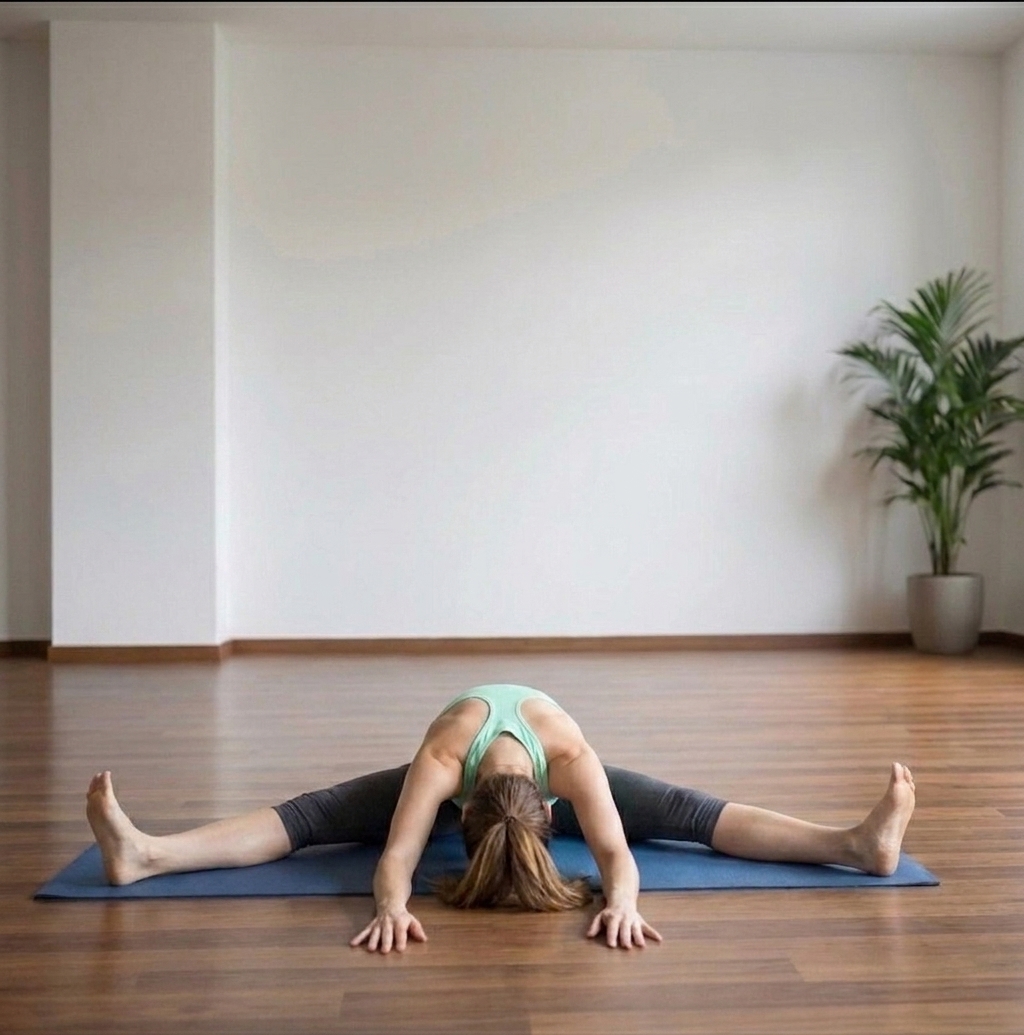
A perfect pancake split (legs out to the sides, torso folded forward to the floor) is impressive. It's also pretty much useless for daily function unless you're a gymnast, martial artist, or serious yogi who wants it for its own sake.
Being able to comfortably sit on the floor, squat down to play with a child, reach overhead to put something on a shelf, bend forward to tie your shoes without your back complaining - that's functional mobility. That's what actually improves your quality of life.
I'm not saying you shouldn't pursue flexibility if it genuinely interests you. If you want to work toward a full split because it's a personal goal, go for it! Just be clear about what you're doing and why.
But if you're feeling inadequate because you're not Instagram-level flexible, let me offer some perspective:
Even Ballet Is Rethinking Extreme Flexibility
You know those famous photos of ballet dancers sleeping in impossible positions - full splits while reading a book, feet behind their heads while watching TV?
They're gorgeous. They've also been part of a culture that might not have been serving dancers' long-term health as well as we thought.
Dr Sue Mayes, Director of Artistic Health at the Australian Ballet, has been involved in research with La Trobe University examining dancers' training and injury patterns. One of the findings? Modern training is shifting toward prioritising strength over extreme flexibility.
Why? Because dancers with greater strength and control throughout their range - not just maximal passive flexibility - tend to have lower injury rates and longer careers.
If the people who need extreme range of motion for their literal profession are discovering that more flexibility isn't always better, what does that tell us about the average person's stretching obsession?
It tells us that control, strength, and functional range matter more than how far you can passively move a joint.
A Word About Hypermobility
I need to briefly mention this because it's more common than people realise, especially in movement communities:
If you're hypermobile (joints that move beyond normal ranges easily), you probably need less stretching, not more. Your limitation isn't range - it's the strength and control to stabilise the range you already have.
Hypermobility, particularly in conditions like Ehlers-Danlos Syndrome, requires a completely different approach to movement. This is a complex topic that deserves its own article (which I may write in future), but for now: if you're hypermobile and always getting told to "stretch more," that might be the opposite of what you need.
I have a client with EDS, and our work together looks nothing like traditional flexibility training. It's all about building stability, control, and strengthening within safe ranges.
So What Should You Actually Do?
Let's make this practical.
For warm-ups: Active, dynamic movement. Wake your body up, rehearse your movement patterns, gradually increase range through active control.
For cool-downs: Gentle passive stretches if they feel good and help you transition out of exercise mode. Just don't expect them to increase your flexibility. They're a nice ritual, not a flexibility practice.
If you actually want to increase flexibility: Dedicate time to proper flexibility work - long holds (3-5+ minutes), with breathwork, in a relaxed state. Think Yin yoga or dedicated stretch sessions. This is separate from your workout, not a 5-minute add-on to it.
If you want to increase mobility (you probably do): Focus on strength work through full ranges, movement quality practices like Pilates or yoga, and consider whether fascial restrictions might be limiting you (this is where myofascial release becomes relevant).
If you're hypermobile: Prioritise strength and stability over stretching. Work with someone who understands hypermobility.
If a muscle is "always tight": Consider whether you need to strengthen something else rather than stretch the tight thing. Look at the whole movement pattern, not just the symptom.
And ask yourself honestly: Do you need extreme flexibility, or do you need functional range of motion that allows you to move comfortably through your actual life?
The answer to that question should guide your practice.
Here's My Honest Take
After 25 years of teaching movement across multiple modalities - Pilates, yoga, stretch coaching, myofascial release - here's what I've learned:
Most people are stretching too much and strengthening too little.
They're chasing flexibility they don't functionally need while neglecting the strength and control that would actually improve how they move through their days.
They're spending 5 minutes after workouts on stretches that feel productive but aren't creating any lasting change, then wondering why they're not more flexible.
And they're often addressing the wrong problem entirely - stretching tight muscles that are tight because something else is weak, or trying to increase range in joints that are already plenty mobile but lack the strength to control that range safely.
Stretching isn't bad. It has its place. Done properly (long holds, dedicated practice, appropriate for your body), it can genuinely increase flexibility.
But for most people, most of the time, what they actually need is:
Stronger muscles through full ranges
Better movement control and coordination
Possibly some fascial release work
And functional mobility for their actual life
Your post-workout stretches can stay if you enjoy them - they're a nice ritual. Just be honest about what they're doing.
If you want real change, you need a real strategy. Not hoping that 30 seconds of hamstring stretching after your workout will eventually make you flexible.
Work With Me
If you're interested in actually understanding what your body needs - whether that's mobility work, strength through range, myofascial release, or yes, strategic flexibility training - this is exactly what I help people figure out.
My approach integrates Pilates for strength and control, yoga for movement quality and awareness, breathwork for nervous system regulation, and myofascial release techniques to address fascial restrictions. I can help you distinguish between what you actually need and what fitness culture tells you you should want.
And if you genuinely want to work on flexibility (not mobility, but actual flexibility), I'm Yin Yoga certified and a qualified Stretch Coach - I can guide you in the kind of practice that actually creates lasting change.
Learn more about working with me →
Anja Dobler Integrated Movement & Breathwork Specialist Based in Berlin | Teaching internationally online www.anjadobler.com