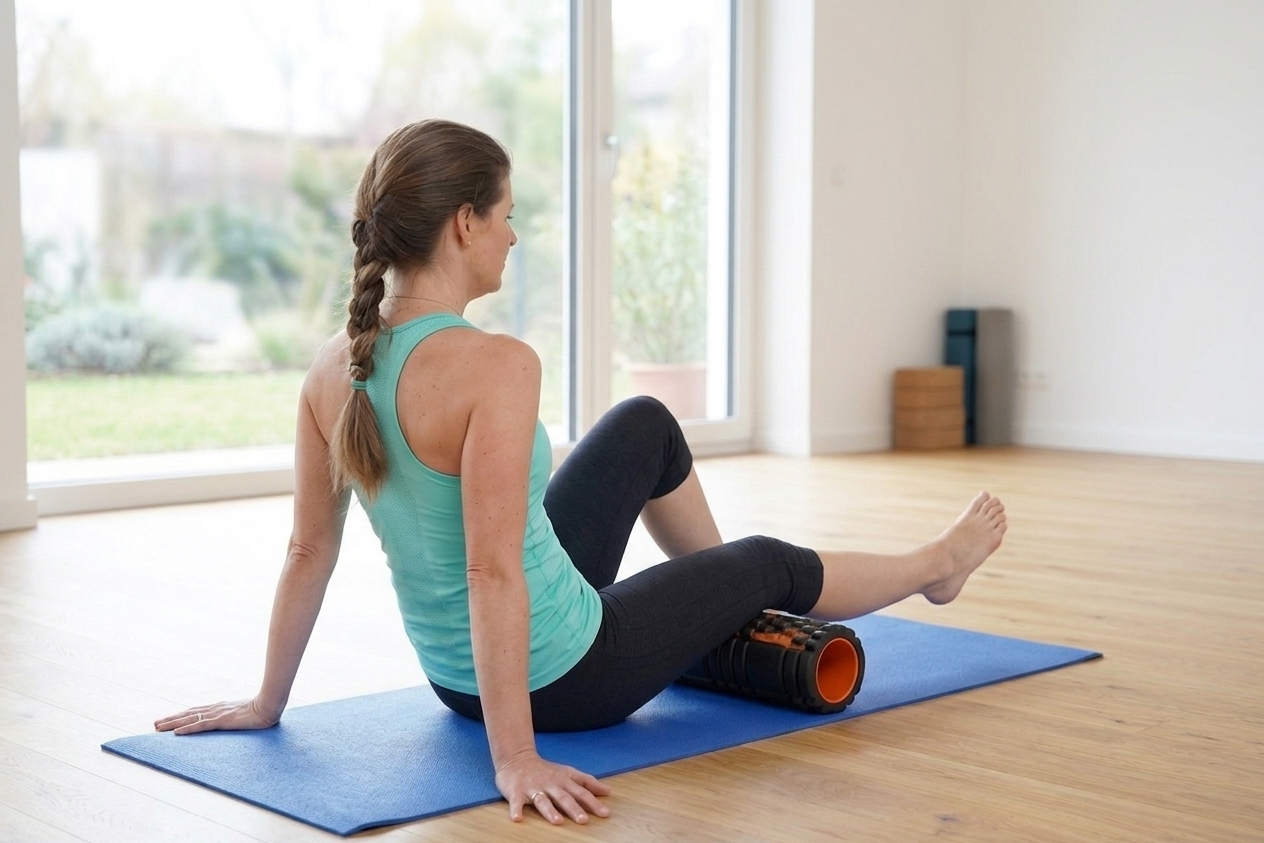
You've probably seen someone rolling around on a ball or a foam roller and pulling a face somewhere between concentration and mild suffering, and wondered what on earth they were doing. Fair question. Let's answer it properly.
What Is Myofascial Release?
Myofascial Release, MFR for short, is a way of working with fascia, your body's connective tissue, to release areas that have become restricted or stuck. Traditionally this is hands-on work: a practitioner applies slow, sustained pressure to a restricted area and waits for the tissue to respond.
Note the word slow. Fascia doesn't respond to speed. Fast, hard pressure tends to make it brace, which is the opposite of what you're after.
So What's the Difference Between MFR and SMFR?
Self-Myofascial Release, SMFR, is the same principle, but you do it yourself, using tools rather than a practitioner's hands. A ball, a roller, sustained pressure, patience.
It's not a lesser version of the real thing. It's a different tool for a different job, one you can do at home, before a workout, at the end of a long day, whenever you like, without booking anyone's time but your own.
Why I'm Genuinely Excited About This One
I teach mostly online these days, which is brilliant for a lot of things and mildly frustrating for one: I can't put my hands on anyone's shoulder and say "here, this bit, right here." SMFR solves that problem neatly. I can teach someone, wherever they are, how to work on their own restrictions themselves. It's a way of helping people help themselves, which is honestly the bit of teaching I like best anyway.
What Actually Is Fascia?
Fascia is the connective tissue that wraps around every muscle, bone, organ and nerve in your body, all in one continuous web with no gaps and no seams. It's not separate from your anatomy, it is your anatomy, in a sense, the scaffolding everything else sits inside.
When it's healthy, it glides. When it's not, whether from injury, repetitive movement, long periods of sitting still, stress, or just the ordinary business of getting older, it can become dehydrated, stiff, or stuck, and that's when you start feeling tightness that stretching alone doesn't seem to touch.
Should It Hurt?
No. It shouldn't hurt. It may well feel uncomfortable, and that's a different thing entirely.
Discomfort is often the sign you're on a restricted spot, the useful kind of sensation that tells you something's happening. Sharp pain is your body telling you to back off. Learning to tell the two apart is most of the skill, honestly, and it's worth taking seriously rather than pushing through on the assumption that more pressure means more progress.
What Tools Do You Actually Need?
There's a whole world of specialised SMFR kit out there, proper fascia balls, therapy rollers, all sorts, and I'm happy to point you towards the ones I rate when the time comes. But you don't need any of it to have a first go.
To get started, you'll likely already have most of this lying around:
If you want to narrow it right down to the bare minimum: a towel, a fairly firm ball, and a big cushion will get you through your first session. Nothing fancy required.
Who Is This For, and Who Should Give It a Miss?
If you carry tension that stretching doesn't seem to shift, sit still for long stretches of your day, or generally like the idea of a self-practice you can build into your own routine, this is likely to suit you.
It's probably not the place to start if you're dealing with an acute injury, a condition that needs a diagnosis first, or you're simply not sure whether what you're feeling is normal tightness or something that needs a professional eye on it. In those cases, go and see someone about it properly before you start rolling around on a ball.
What Does the Evidence Actually Say?
I'll stay on the honest side here, because SMFR gets oversold constantly online. What's genuinely well supported: reduced perceived muscle tightness, short-term improvements in range of motion, and a real effect on how relaxed your nervous system feels afterwards, since slow sustained pressure appears to calm the fight-or-flight response rather than just working the tissue itself.
What it isn't: a fix for structural problems, a replacement for physiotherapy where that's what's actually needed, or something that undoes itself in five minutes flat if you only ever do it once a month. Like most things in this world, a little, often, beats a lot, occasionally.
That's the beginner's version. If you fancy having a go before I share more, a towel and a fairly firm ball is genuinely all you need to find out what the fuss is about.